Welcome! If you’re visiting for the first time, this essay offers the clearest introduction to what this site is about: a psychology that honors science, meaning, symbolism, and our place within a living cosmos. It lays out the key ideas that shape the work here which are inclusive of the four ways of knowing to a renewed understanding of the psyche’s geocosmological horizon. Begin here, and let the rest unfold from this starting point. The sidebar (Recent Posts) gives you the option of selecting essays by title.
Geocosmology
Our ancestors developed cosmologies through careful observation of the stars, recognizing their relationship not only to the heavens, but to the Earth as well. In doing so, they gave rise to symbolic forms such as mandalas that mirror cosmic patterns, among the most potent of these being astrological charts and later natal birth charts. Through such symbolic systems, the psyche comes to a deeper awareness of itself, revealing that it is not isolated, but part of an interconnected and interrelated whole grounded in meaning.
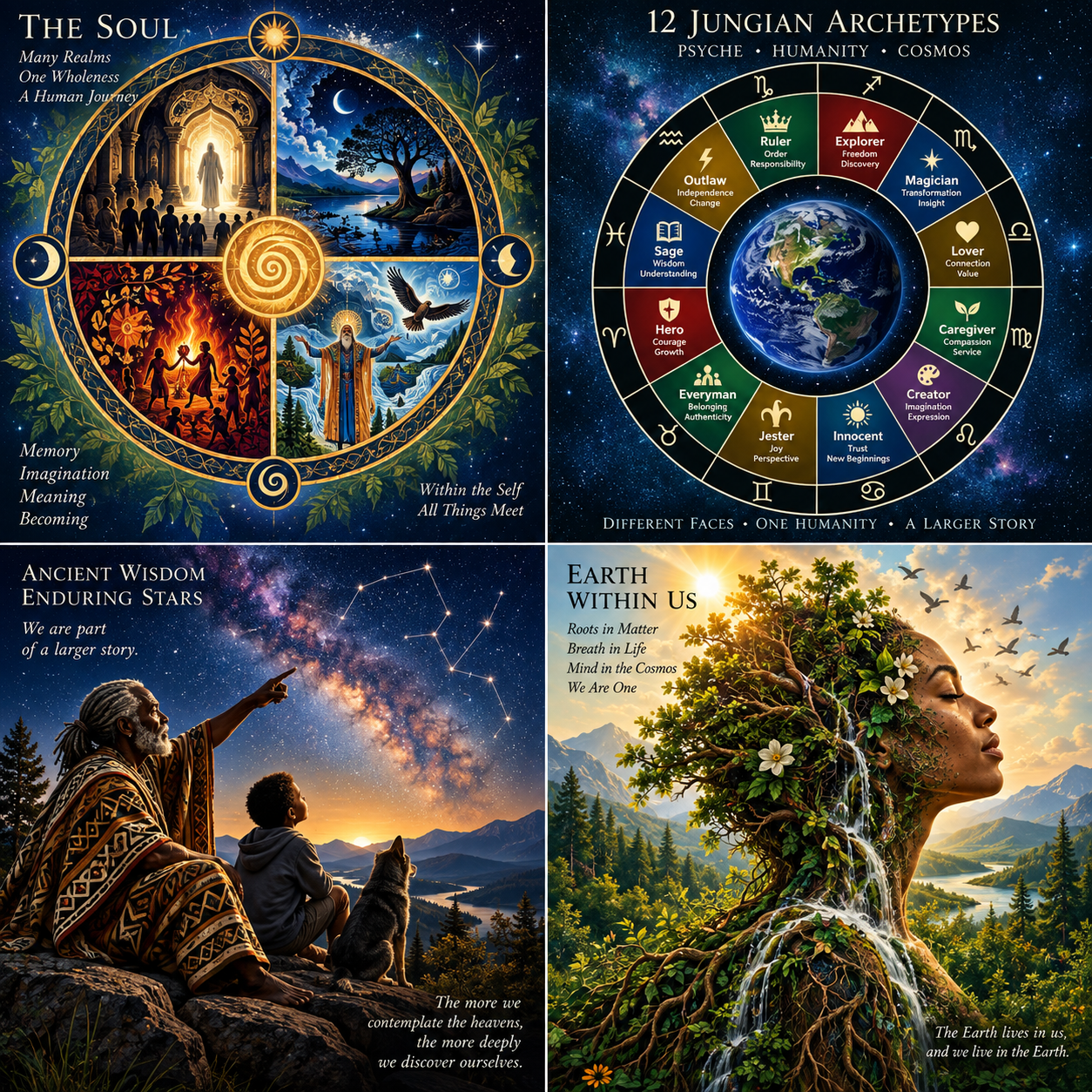
On Soul, Spirit, Consciousness, and Psyche: Four Words for the Inner Life
Soul, spirit, consciousness, and psyche are often spoken of as though they were synonymous, yet each names a distinct, overlapping dimension of human existence. Consciousness refers to awareness itself. Psyche and soul share the same individual ground, but psyche represents the structural totality—both conscious and unconscious—through which we participate in the world, while soul is its experiential depth: the internalized essence through which meaning, suffering, joy, and transformation are encountered. Spirit refers to the transcendent, unifying presence that encompasses the psyche, drawing the individual beyond the isolated personality into a deeper relationship with humanity, the cosmos, and the sacred. Each is understood here as fundamentally nonmaterial.
A “sick soul” generally refers to a disturbance in the person’s deep meaning-bearing center that can reveal a condition of alienation, despair, emptiness, fragmentation, moral conflict, loss of purpose, or estrangement from one’s deeper self and values. In this sense, the soul is “wounded” not medically, but existentially and symbolically.
“Spiritual sickness,” by contrast, usually points more toward a disturbance in one’s relationship to what is regarded as sacred, transcendent, ultimate, or spiritually grounding. It may involve feelings of disconnection from God, spirit, cosmos, community, ancestry, or transcendent purpose. In some traditions, spiritual sickness is understood as arising when life becomes excessively materialistic, ego-centered, fragmented, or cut off from deeper transpersonal or spiritual realities. A wounded soul may lead to spiritual crisis, and spiritual alienation may wound the soul.

Cosmos, Ancestors, and Earth
Across time and tradition, soul, spirit, and consciousness have been understood as more than the body and more than the isolated self that’s contained within a single lifetime. Indeed, they have been viewed as capable of continuing beyond bodily existence as a distinct presence, as a living thread woven through the web of ancestry and cosmos, or as a wave that, having traveled the full distance of a life, returns at last to the greater ocean of being from which it arose..
The Pulse of the Pattern: Intuition as a Bridge to the All
Passages Beyond the Gate: a Jungian Approach to Understanding American Psychology, and the website passagesbeyondthegate.com are guided by the understanding that intuition is foundational to humanity’s capacity for far-reaching symbolic insight and that the psyche does not stand apart from the world, but participates in a meaningful continuity with it.
Long before psychology became a discipline, human beings experienced the 24 hours day/night cycle. In certain parts of the Earth humans experienced seasonal changes. Humankind readily looked to the heavens and saw not empty space, but pattern, rhythm, and meaning. The movements of the stars were not distant, detached events, but patterns actively mirrored in both the human soul and the living soil. From these observations emerged cosmologies which are living frameworks in which the human psyche was understood as part of a greater, ordered whole.
Daylight summoned the soul outward, commanding the body to explore, build, and venture into the illuminated world. Night brought an equally sacred counterbalance which was a quiet summons to stillness, dream, and cellular repair. Yet darkness was never a mere absence of light; it carried its own revelation. By cloaking the immediate surroundings, night lifted the veil on the infinite, granting early humans their only glimpse of the cosmos through the brilliance of the stars. Where daylight revealed the earthly path, the night sky unveiled the transcendent architecture of eternity.
In lands marked by the turning year, the seasons deepened this dialogue with the spirit. Spring offered the soul lessons in resurrection and new beginnings; summer celebrated peak vitality; autumn often demanded a slow surrender, the harvest, and the gathering of inner reserves; and winter, reminiscent of the soul’s descent into melancholia, stood as the necessary womb of dormancy, teaching that life can persist even in the frozen dark. Through each shift of light and weather, the cosmos did not only surround early humans, it instructed them, shaping their inner lives to mirror the great pulse of the universe.

This work returns to that insight, not as a rejection of science, but as its necessary expansion.
The Measured Mind and Its Limits
In its modern form, mainstream American psychology has gained extraordinary power by narrowing its focus. It has learned to measure, predict, and analyze with precision, yet in doing so, it has often bracketed the very dimensions that give human life its depth: symbol, value, intuition, and the sense of participation in something larger than oneself.
When consciousness is treated as secondary—that is, to say, understood primarily in terms of underlying biological or computational processes, then the lived world of perception, value, symbol, and meaning begins to lose its depth. Experience is reduced to what can be measured and explained, while its significance and symbolic richness gradually recede.
The Integrative Vision
Against this, Passages Beyond the Gate advances an integrative vision of the psyche, grounded in scientific inquiry while remaining open to the symbolic, spiritual, and geocosmological dimensions of human experience.
In this view, consciousness is understood not as an epiphenomenon of biological substrates, but as a primary ontological reality within which somatic form arises. The brain serves as an organ of transmission and constraint, mediating consciousness in physical space and time without originating it. Fundamentally non-dual, the psyche and the somatic body participate as differentiated expressions of one living whole, revealing a continuum of meaning that encompasses organism, culture, Earth, and cosmos.
Here, the insights of Carl Jung take on renewed force. Jung did not described the psyche as merely personal. While it is shaped by lived experiences that includes the body, its sensations, development, and the contingencies of life—it is at the same time expansive, structured in such a way that it remains open to archetypal patterns and transpersonal realities. The individual, in this sense, does not generate meaning in isolation, but participates in a wider field of symbolic and psychological processes that both ground and exceed personal experience.

Four Ways of Knowing
To approach the psyche seriously is to recognize that knowing does not proceed from a single source. It unfolds through a set of distinct yet interdependent capacities, each revealing a different face of reality, each incomplete on its own. Passages Beyond the Gate builds upon the work of Carl Jung by understanding his four psychological functions: sensation, thinking, feeling, and intuition though not simply as typological categories, but as fundamental ways of knowing. In this light, they can be seen as underlying orientations that shape how different psychological approaches emerge and what aspects of human experience they bring into focus.
Sensation identifies the concrete and measurable. It brings us into contact with what is present, what can be encountered, touched, and verified. It is the ground upon which experience stands, the point at which consciousness meets the world as fact.
Thinking generates understanding via causal explanation and classification. Through its capacity to categorize inner and outer phenomena, it differentiates, orders, and renders intelligible what would otherwise remain undistinguished. In Jung’s sense, thinking tells us what a thing means. It clarifies its nature, its definition, and its place within a broader field of understanding. Through thinking, the psyche gains clarity. But clarity alone does not yet tell us why something matters.
Feeling reveals value. It does not determine what a thing is, but what it is worth. It discloses significance revealing what matters, what carries weight, what calls for affirmation or refusal. Through feeling, the psyche comes to know not just the meaning of things, but their importance.
Intuition is inherently directional. As Jung suggested, it concerns itself with the movement of things capturing a sense of their emergence and their direction. It recognizes origin and what is forming beneath the surface of the present moment: the patterns not yet visible, the trajectories already underway, the future implicit within what is now. Through intuition, the psyche does not merely register reality, it participates in its unfolding.
Each of these functions speaks truly, but never completely. Taken in isolation, they narrow the field of understanding. Brought into relation, they begin to widen it. Their integration does not collapse their differences, but holds them together allowing the psyche to move beyond fragmentation toward a more coherent apprehension of the real.

Towards Wholeness
Through this integration, the psyche moves toward wholeness in an ongoing process of becoming. Here, the individual enters into deeper communion with the self, the world, and the larger cosmic patterns holding both. The task, then, belongs not to the solitary seeker alone, but to humanity as a whole: to seek a balanced integration that carries forward the empirical strengths of modern psychology, science, and emerging artificial intelligence, while bringing them into dynamic dialogue with the intuitive wisdom and enduring meanings of our ancient past.
To re-enfranchise the soul is not to turn away from what American psychology has become, but rather to extend it and to restore to it what has been set aside, ignored, or denied. Actions taken to re-enfranchise the soul are done to promote the recognition that the human being is not merely a collection of functions or processes, but a participant in a reality that is at once material, symbolic, meaningful, and in motion.
In this recognition, American psychology finds its way forward not by narrowing its vision, but by widening it until it is capable of holding Earth and cosmos within an integrated scientific, psychological, and metaphysical understanding of the human being. Such a widening responds to the fragmentation that increasingly characterizes modern life: the division between science and spirituality, self and nature, intellect and meaning, individual and community, humanity and cosmos. What emerges instead is a more unified vision of human existence that restores continuity between inner life and the greater reality in which it participates. For the individual who stands at the gate and crosses its threshold, the journey opens onto previously unknown vistas and awakens a deepening inner awareness that continues to unfold with each step taken.
Further Reading
Jennings, G.-H. Passages Beyond the Gate: A Jungian Approach to Understanding American Psychology
Jung, C. G. Psychological Types
Cunningham, L.B. The Mandala Book: Patterns of the Universe
Aveni, A. People and the Sky: Our Ancestors and the Cosmos
Barry, T. Evening Thoughts: Reflecting on Earth as a Sacred Community

© 2026 George-Harold Jennings. All rights reserved.


