
A truly unified psychology recognizes the human being as a whole, integrated, and transcendent being.
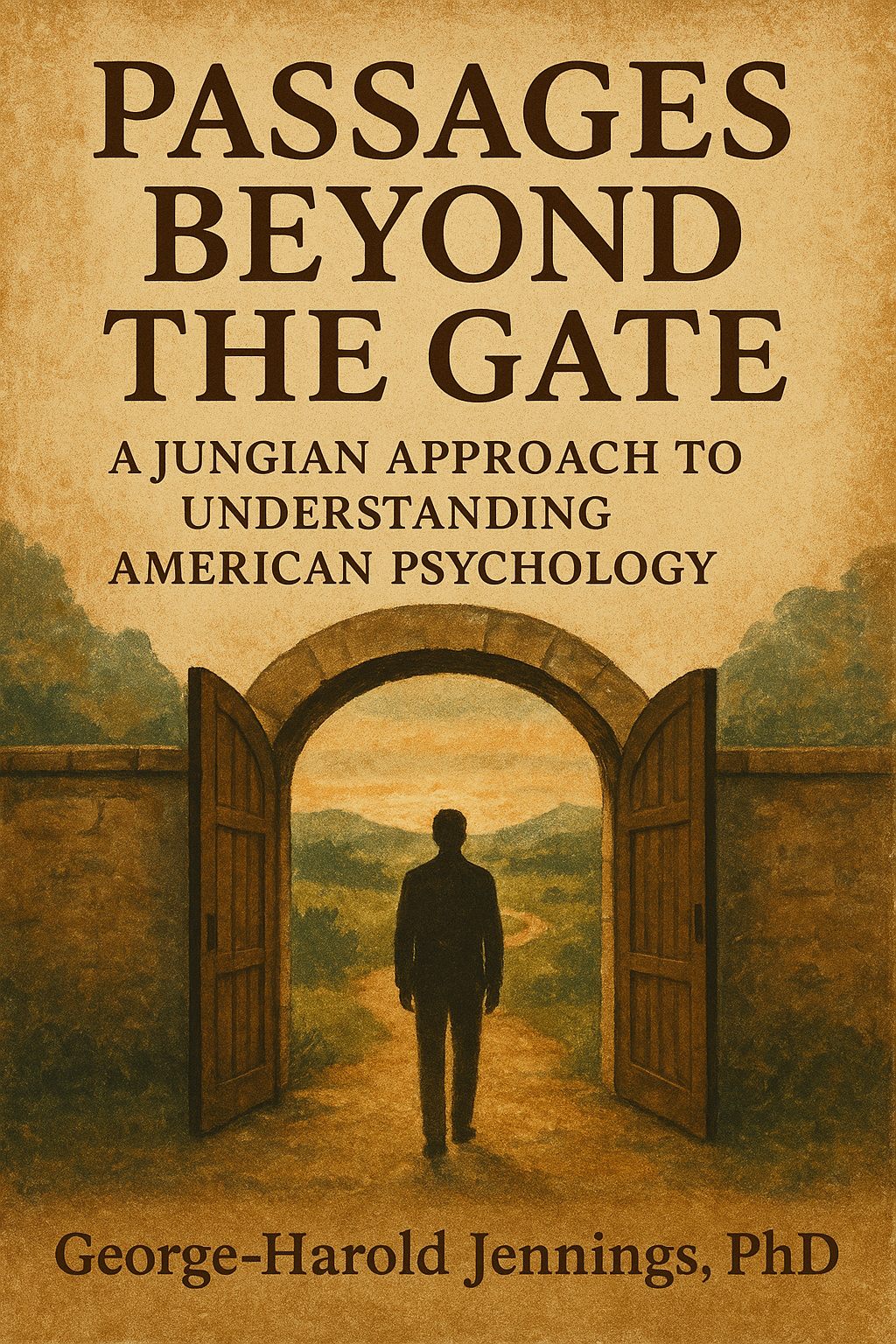
American psychology today stands at a critical threshold. It is a threshold marked by increasing fragmentation on the one hand and a growing call for integration on the other. Across diverse traditions, an emerging movement seeks a more unified and adequate understanding of the human being, as reflected in the work of William James, Carl Rogers, Abraham Maslow, Rollo May, Linda James Myers, and Ken Wilber. What unites these perspectives is the recognition that the human psyche cannot be reduced to any single method of inquiry, but must instead be understood as a complex, layered, and dynamic whole. It is within this broader movement that Passages Beyond the Gate: A Jungian Approach to Understanding American Psychology situates itself, proposing that American psychology moves toward greater wholeness only when it fully integrates the transpersonal, spiritual, and culturally grounded dimensions of human life. The book joins in on a broadened vision of psychological understanding by arguing that American psychology can move toward greater wholeness only when it fully acknowledges the transpersonal and spiritual dimensions of human life.
Drawing on Jungian depth psychology while remaining in dialogue with contemporary developments in behavioral and cognitive science, neuroscience, psychodynamic theory, and humanistic–existential psychology, the book suggests that the discipline has long struggled with fragmentation precisely because it has often marginalized questions of meaning, spiritual development, and the deeper symbolic journey of the psyche.
Over the past decade, fragmentation within American psychology has only intensified. Compounding this condition is the growing influence of AI-driven algorithmic reductionism centered on the view that the human being may be reduced to little more than a set of predictable data points. The field now finds itself stretched across behavioral-cognitive models, neurobiological reductionism, and psychodynamic, humanistic, and existential approaches in both theory and practice. It also encompasses algorithmic behavioral prediction involving the application of mathematical models and data to forecast behavior, and strictly evidence-based approaches within positive psychology. Trauma-centered practices, while invaluable, can at times risk organizing identity around injury rather than possibility if not held within a broader developmental frame. Amid these divergent developments is a renewed, though still limited, interest in spirituality and meaning-making.

As psychology fragments into competing frameworks and reduces the human being to data, it risks losing sight of the full depth, meaning, and possibility of human existence.
Each of these movements carries genuine insight; yet, in their relative isolation from one another, they have contributed to a profession that struggles to articulate a coherent vision of the human being. The modern psychologist (unless choosing to privilege certain roles over others) is thus called upon to be scientist, healer, technician, and, at times, a spiritual companion and often without a unifying framework capable of holding these roles together.
In his writings, Jung (1971) identified and described four psychological functions: sensation, thinking, feeling, and intuition. Sensation establishes what is present; thinking determines what it is and how it can be understood; feeling evaluates its value; and intuition perceives its deeper significance, origin, potential direction and/or possibilities. Passages Beyond the Gate uses these functions as the basis of its theoretical framework, thereby advancing a holistic and structurally integrative approach.
Consider the life of an individual who begins therapy through the lens of trauma—an approach modern clinical practice often enters through the body, regulation, and somatic awareness (sensation); or through neuroscience (sensation), or behavior modification (primarily sensation, with elements of thinking). Over time, the individual may gain cognitive insight (thinking), come to identify one’s values (feeling), and eventually confront deeper questions of meaning, purpose, interrelatedness, and possibilities (intuition). At each stage, a different psychological framework proves helpful—but none alone proves sufficient.

Wholeness begins when we stop choosing between perspectives and start integrating the full complexity of the human experience.
True healing occurs only when these perspectives are no longer experienced as competing explanations, but as complementary layers within a larger understanding of the self. What begins to emerge at this point is not merely an eclectic blending of approaches, but a structurally integrative framework of the psyche in which biology, behavior, cognition, values, symbolism, consciousness, community, and meaning are understood as distinct yet interdependent dimensions of human experience.
Passages Beyond the Gate advances precisely this model: a developmental, meta-theoretical integration of the psychological functions, in which sensation, thinking, feeling, and intuition are understood not as isolated capacities, but as organizing principles capable of holding together the scientific, clinical, cognitive, emotional, value-laden, symbolic, and transcendent domains of psychology within a single, coherent vision. A developmental model understands the human being not as fixed, but as an unfolding process in which different ways of knowing: empirical, rational, emotional, intuitive, and transcendent emerge over time and call for integration.
An Unfolding Vision for Psychologists
By emphasizing the importance of the neglected transpersonal, spiritual, and meaning-making dimensions into psychological thought and practice, Passages Beyond the Gate outlines a path forward in which one vision of the modern psychologist among several that shape the contemporary field recognizes the human search for meaning, the transformative potential of the spiritual journey, and the necessity of integrating empirical science with the inner, symbolic, and transpersonal dimensions of experience. In doing so, the work points toward a future for psychology that is both scientifically grounded and psychologically complete as well as capable of addressing not only the mechanisms of mind and behavior but also the deeper existential and spiritual needs that shape the human condition.
For decades, American psychology has lived in fragments that remain divided among powerful and compelling advances in our understanding of human nature, led by scientific approaches inclusive of the theories and frameworks of the behavioral, cognitive, and biological, as well as the insights offered by psychodynamic, and humanistic-existential approaches. But what happens when we finally bridge the gap between science and the intuitive soul? We will stand in the presence of a psychology closer by far to completion than not.
A Rare Trajectory for a Book
In an era when AI, neuroscience, and contemplative traditions are converging in unexpected ways—though it is still more of a dialogue than a full integration, Passages Beyond the Gate offers a symbolic and psychological architecture capable of holding these developments. Although it is a layered work: existential, rich in metaphors, and archetypal symbolism, Passages Beyond the Gate, first runner-up in the Eric Hoffer Book Award Spiritual Category, and Montaigne Medal finalist in 2011, is ultimately a meta-theoretical critique of American psychology.
In a review of the monograph originally published in 2010, James Hollis observed: “In Passages Beyond the Gate, Dr. Jennings calls American psychology to accountability for its own blind spots.” Chief among these, Hollis suggested, is the discipline’s failure to recognize the importance of engaging the intuitive and spiritual dimensions of the human journey which is an essential aspect of human nature. As a result, questions of meaning have too often been set aside, contributing to a psychology that is both fragmented and incomplete.
Writing in the December 2025 issue of the Journal of Transpersonal Psychology, Volume 57 No.2, the premiere journal in the field, Beth Cooper Tabakin, Ph.D., shares a personal shift. She notes that the book “personally and professionally changed me.” She characterizes the book as a “punctuation point to healing possibilities” and a “gem” for anyone interested in personal growth and a more expansive view of psychology as a discipline.
Commenting on the book fifteen years ago, James Hollis’s early recognition finds meaningful continuity in the 2025 review published in the Journal of Transpersonal Psychology by Beth Cooper Tabakin, whose reflections speak not only to the enduring relevance of Passages Beyond the Gate, but to its lived impact. That the work continues to be engaged: first through Hollis’s interpretive lens and now through Tabakin’s personal and professional response suggests a trajectory that is less episodic than cumulative.
That these reviews have emerged fifteen years apart feels symbolically fitting. The book was written to speak across multiple landscapes—temporal, personal, cultural, and archetypal—and its reappearance in professional discourse suggests that the questions it raises have ripened rather than faded.

When science, meaning, values and consciousness meet, psychology becomes equal to the human being it seeks to understand.
Passages Beyond the Gate may be understood as a meta-theoretical model in that it does not propose a new psychological theory among others, but rather articulates a structurally integrative framework through which the diverse and often competing theories of psychology can be understood as partial expressions of a more comprehensive vision of the human being. The work seems to be finding its readers at moments when they are most prepared to engage its deeper implications.
I am deeply grateful to the Editorial Board of the Journal of Transpersonal Psychology for publishing a retro review of my book, and to Dr. Tabakin for the care and seriousness with which she approached the work. Together, the moments of 2010 and 2025 stand not as isolated acknowledgments, but as part of an unfolding recognition of Passages Beyond the Gate—a book that speaks to the individual’s personal journey while also offering a diagnosis of the fragmented state of American psychology and an invitation to participate in its ongoing healing.
Foundations & Further Reading
The works listed below reflect several of the major streams of thought that have shaped modern psychology—along with those that point beyond its current fragmentation. Organized thematically, they mirror the movement from empirical science to depth, meaning, and ultimately, transpersonal integration.
Cognitive, Behavioral, and Contemporary Scientific Psychology
(Empirical Foundations of Modern Psychological Science)
Kahneman, D. Thinking, Fast and Slow
Hayes, S. C. Acceptance and Commitment Therapy
Christian, B. The Alignment Problem
Zuboff, S. The Age of Surveillance Capitalism
Neuroscience, Mind–Body Integration, and Trauma
(The Emergence of Embodiment and Psychophysiological Healing)
Porges, S. W. The Polyvagal Theory
Siegel, D. J. The Developing Mind
van der Kolk, B. A. The Body Keeps the Score
Levine, P. A. Waking the Tiger: Healing Trauma
Humanistic and Existential Psychology
(The Turn Toward Meaning, Experience, and Human Potential)
Maslow, A. H. Toward a Psychology of Being
Rogers, C. On Becoming a Person
May, R. Man’s Search for Himself
Csikszentmihalyi, M. Flow: The Psychology of Optimal Experience
Depth Psychology and the Structure of the Psyche
(Symbol, Archetype, and the Architecture of the Inner World)
Jung, C. G. Psychological Types
Jung, C. G. The Archetypes and the Collective Unconscious
Transpersonal, Spiritual, and Cosmological Psychology
(Toward the Integration of Psyche, Spirit, and Cosmos)
James, W. The Varieties of Religious Experience
Grof, S. Beyond the Brain
Carhart-Harris, R. L. Research on psychedelic-assisted therapy
Systems, Ecology, and Holistic Worldviews (Reintegrating Mind, Nature, and the Larger Order of Reality)
Capra, F. The Web of Life
Bateson, G. Steps to an Ecology of Mind
Tarnas, R. Cosmos and Psyche
Toward Integration: A Unifying Framework
Jennings, G.-H. Passages Beyond the Gate: A Jungian Approach to Understanding American Psychology
Myers, L. J. Understanding an Afrocentric worldview: Introduction to an Optimal Psychology
Wilber, K. Integral Psychology
Taken together, these works illuminate both the strengths and the limitations of contemporary psychology. They also point toward a broader, more unified vision—one in which scientific insight, depth understanding, and transpersonal awareness are no longer divided, but brought into meaningful dialogue.
______________________________
Links:
The Association for Transpersonal Psychology promoting a vision of the universe as sacred
___________________
Download: The link at the top is for downloading an alternative image for Passages Beyond the Gate: a Jungian Approach to Understanding American Psychology

© 2026 George-Harold Jennings. All rights reserved.
Contact: gjenning@drew.edu


Leave a Reply